Today, I highlight 2 topics that I recently learned about in at intersection of Sustainability and AI.
- Carbon Accounting
- Software Carbon Intensity (SCI)
Carbon Accounting refers to measuring and tracking the amount Greenhouse Gases (GHG) emitted by during an activity. I’ve attached a widely used image by EPA that shows the sources of emissions throughout the value chain and how they’re categorized by Scope 1, 2, 3.
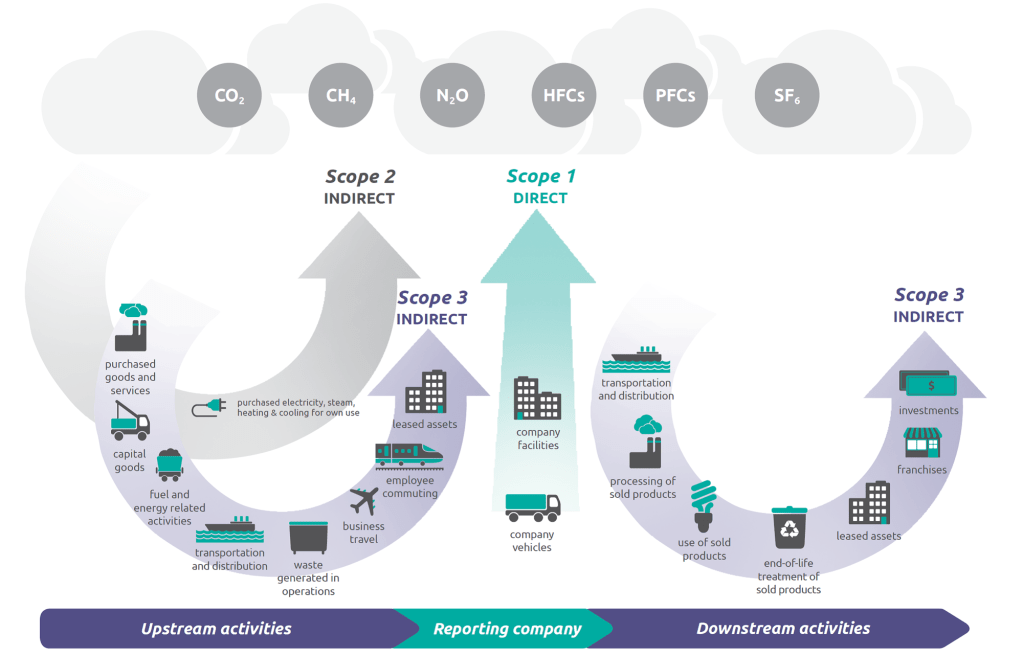
Scope 3 is the most notorious and includes embodied emissions, making it the most challenging to track, measure, and report.
For AI applications it means collecting data about both hardware and infrastructure components, largely energy consumption data centers and processors used to run the model for training or inference. This results in embodied and operational emissions.
After collecting three data, we can calculate the Software Carbon Intensity (SCI), which is the measure the carbon footprint of the software. The formula for that is
SCI = (E * I) + M / R
Where:
- E – represents the energy consumed by the software.
- I – is the carbon intensity of the energy grid powering the data center.
- M – accounts for the embodied emissions of the hardware, which includes the carbon footprint of manufacturing, transportation, and disposal.
- R – is the functional unit, such as the number of users or API calls, allowing SCI to scale based on software usage
While researching more I found some from an article that provides a detailed analysis of measuring carbon intensity.
The bottom line is that the road to gathering emissions data, that companies need to measure and improve their footprint, is long and complex.
With advent of IoT and stricter regulations for sustainability reporting, organizations definitely have a few cards up there pocket to make a sizeable impact, especially in the cloud computing and AI sector.
Most small to medium companies can’t afford to be choosy in picking the hardware to run the AI model (and SaaS applications). These are fairly standardized and large players like Amazon Cloud, Google Cloud, and Azure.
However, they are opportunities to improve the application performance by leveraging techniques like model pruning, prompt engineering, and utilizing carbon free energy for your operations whenever possible.
Is it possible to create a carbon friendly AI application? Food for thought.
 Sustainability For All
Leave a comment